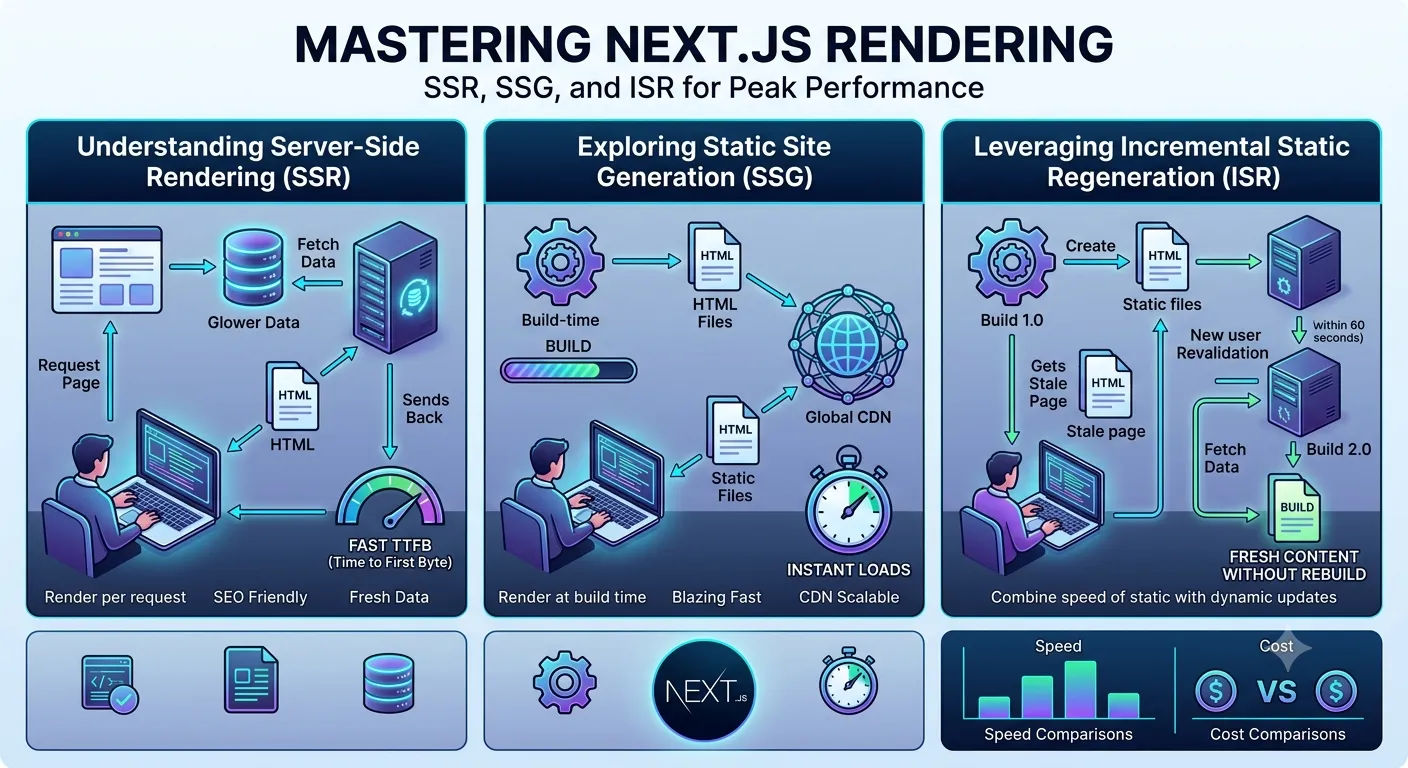
Mastering Next.js Rendering: SSR, SSG, and ISR for Peak Performance
Mastering Next.js Rendering: SSR, SSG, and ISR for Peak Performance
In the world of modern web development, performance isn't just a luxury; it's a necessity. Users expect instant load times, and search engines reward fast sites with higher rankings. Next.js, a powerful React framework, provides a spectrum of rendering strategies to help developers achieve optimal performance: Server-Side Rendering (SSR), Static Site Generation (SSG), and Incremental Static Regeneration (ISR).
Understanding Server-Side Rendering (SSR)
Server-Side Rendering (SSR) allows your Next.js application to render pages on the server for each request. This means that when a user requests a page, the server fetches the necessary data, renders the HTML, and sends a fully-formed page to the client.
Benefits of SSR:
SEO: Search engine crawlers can easily index fully rendered HTML content.
Fresh Data: Pages always display the most up-to-date information, ideal for dynamic content that changes frequently.
Faster Time to First Byte (TTFB): Users see content sooner, improving perceived performance.
In the modern Next.js App Router era, traditional functions like getServerSideProps are replaced by simply using dynamic data fetching within Server Components, setting the cache: 'no-store' option:
TypeScript
// app/dynamic-data/page.tsx (App Router Dynamic SSR Example)
import prisma from "@/lib/prisma";

async function getDynamicData() {
  // cache: 'no-store' triggers Server-Side Rendering (SSR) on every request
  const res = await fetch(`https://api.example.com/data`, { cache: 'no-store' });
  if (!res.ok) throw new Error('Failed to fetch real-time data');
  return res.json();
}

export default async function SSRPage() {
  const data = await getDynamicData();

  return (
    <div className="p-6">
      <h1>Dynamic Server-Side Rendered Page</h1>
      <pre>{JSON.stringify(data, null, 2)}</pre>
    </div>
  );
}
For applications demanding high responsiveness and real-time data, understanding SSR's nuances is crucial. This can be especially important when building a high-performance Next.js 15 micro-SaaS where every millisecond counts.
Exploring Static Site Generation (SSG)
Static Site Generation (SSG) is the gold standard for performance. With SSG, your Next.js pages are rendered into static HTML files at build time. These files can then be served globally from a CDN, offering unparalleled speed and scalability.
Benefits of SSG:
Blazing Fast Performance: Pages are pre-built, leading to instant loads.
Cost-Effective: Serving static files requires less server compute infrastructure.
Security: Less runtime server-side logic reduces the potential attack surface.
In the App Router, data fetching inside Server Components is static by default. For dynamic routes, you use generateStaticParams instead of the old getStaticPaths: