Unlocking Real-Time Insights: Why Edge AI is the Future for Business
Unlocking Real-Time Insights: Why Edge AI is the Future for Business
In a world increasingly driven by data, the speed at which businesses can process information and act upon insights is paramount. For years, the cloud has been the undisputed king of data processing, offering immense computational power and scalability. But what if waiting for data to travel to the cloud and back is no longer fast enough? What if privacy concerns dictate that sensitive information shouldn't leave its source? Enter Edge AI – a transformative technology bringing the power of artificial intelligence directly to where the data is generated: at the 'edge' of your network.
This isn't just a technical shift; it's a strategic imperative for businesses looking to gain a competitive advantage. Imagine instantaneous responses, enhanced data security, and significant operational efficiencies. That's the promise of Edge AI for business, and it's rapidly moving from niche application to mainstream necessity. As more devices become 'smart' – from factory sensors to retail cameras – the demand for on-device AI processing capabilities is skyrocketing, making now the perfect time to understand and strategize its integration.
What Exactly is Edge AI?
At its core, Edge AI refers to running AI algorithms directly on local devices or 'edge' servers, rather than sending all data to a centralized cloud for processing. Think of it as decentralizing AI. Instead of a smart security camera sending every frame to a cloud server to detect motion, an Edge AI-enabled camera processes the video on the device itself, only sending an alert (or metadata) when something significant happens. This local processing capability allows for real-time AI inference, dramatically reducing latency and dependence on constant network connectivity.
This paradigm shift is crucial because it addresses critical limitations of purely cloud-based AI, especially as the sheer volume of data generated by IoT devices continues to explode. While cloud AI remains vital for training complex models, Edge AI focuses on efficient, localized execution of those models.
Why Edge AI Matters Now: Key Benefits for Business
The timing for Edge AI couldn't be more opportune. Several converging factors – the proliferation of IoT devices, increasing demands for data privacy, and the need for immediate decision-making – are pushing Edge AI to the forefront. Here's why businesses are increasingly turning to this technology:
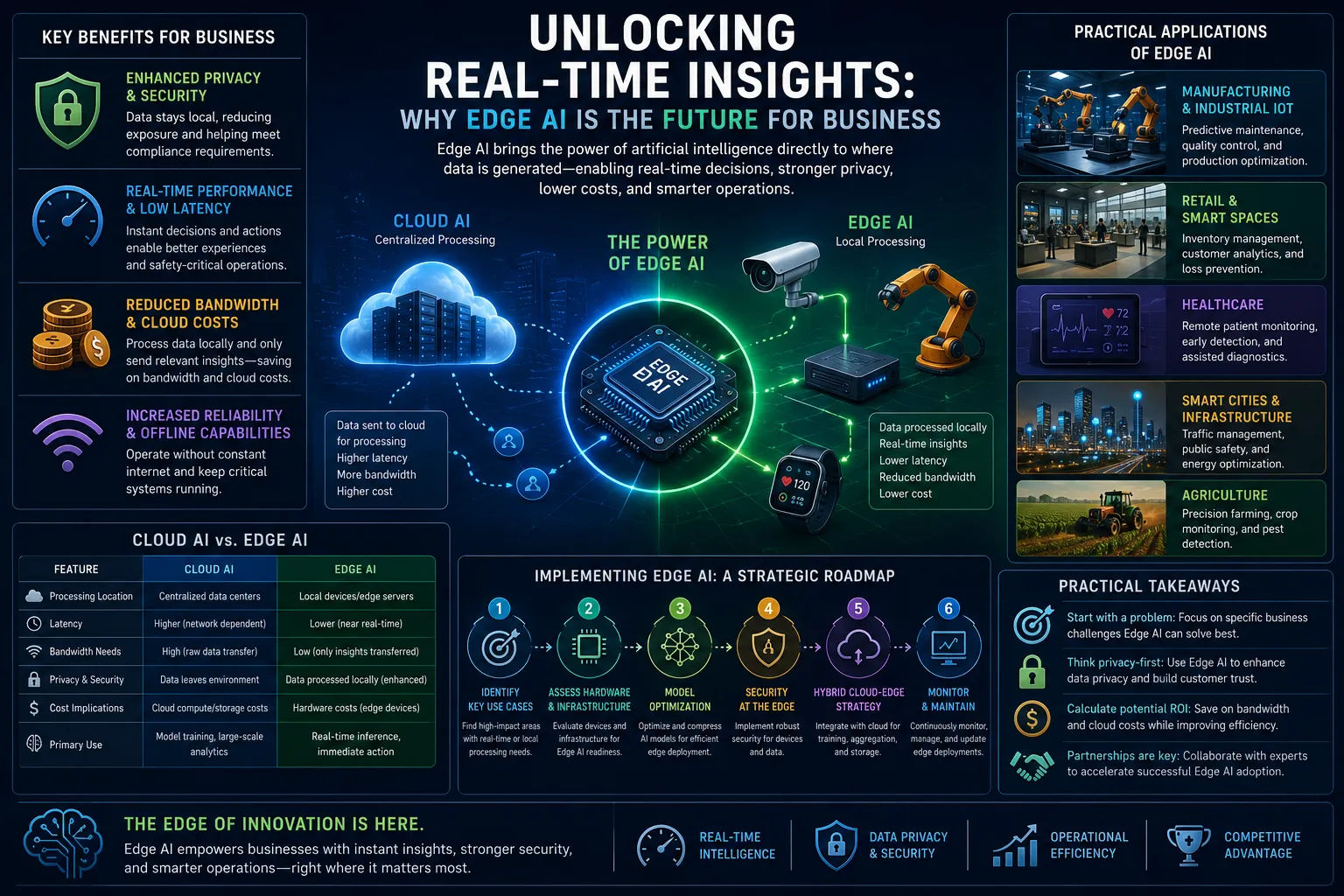
1. Enhanced Privacy & Security
One of the most compelling advantages of Edge AI is its inherent ability to bolster data privacy and security. By processing data locally, sensitive information doesn't need to travel across networks to a centralized cloud, minimizing exposure to potential breaches. For industries handling personal or proprietary data, such as healthcare, finance, or even internal corporate operations, this is a game-changer. It helps businesses comply with stringent data protection regulations like GDPR and CCPA, mitigating risks and building customer trust. When you consider the growing importance of ethical AI, AI governance extends to where and how data is processed, making Edge AI a key component of a responsible AI strategy.
2. Real-time Performance & Low Latency
For applications where milliseconds matter, Edge AI is indispensable. Think autonomous vehicles, robotic automation in manufacturing, or instant fraud detection at a point of sale. By eliminating the round trip to the cloud, Edge AI enables real-time AI processing, allowing devices to make immediate decisions based on local data. This low latency is critical for safety-critical systems and applications demanding instantaneous feedback, directly impacting operational efficiency and user experience.
3. Reduced Bandwidth & Cloud Costs
Sending massive amounts of raw data to the cloud for processing is expensive, both in terms of bandwidth consumption and cloud storage/compute costs. Edge AI significantly reduces this burden by processing data locally and only sending relevant insights or aggregated data to the cloud. This can lead to substantial cost savings, particularly for operations with numerous IoT devices generating continuous data streams.
4. Increased Reliability & Offline Capabilities
Cloud connectivity isn't always guaranteed, especially in remote locations or during network outages. Edge AI devices can operate autonomously, performing their functions even without an internet connection. This enhanced reliability is crucial for mission-critical applications where downtime is not an option, ensuring continuous operation and data processing regardless of network availability.
Practical Applications of Edge AI for Business
The versatility of on-device AI means it's finding applications across a diverse range of industries:
- Manufacturing & Industrial IoT: Predictive maintenance on machinery, quality control via real-time visual inspection, and optimizing production lines. Edge AI sensors can detect anomalies and prevent costly breakdowns before they occur.
- Retail & Smart Spaces: Real-time inventory management, customer behavior analytics (without identifying individuals), personalized in-store experiences, and loss prevention through immediate anomaly detection. This helps retailers optimize layouts and staffing.
- Healthcare: Remote patient monitoring, early disease detection from wearables, and assisted diagnostics in clinics. Edge devices can process patient data locally, ensuring privacy while providing immediate insights to caregivers.
- Smart Cities & Infrastructure: Intelligent traffic management, public safety monitoring (e.g., detecting unusual activity), and optimizing energy consumption in buildings. Local processing helps manage vast networks of sensors efficiently.
- Agriculture: Precision farming, crop health monitoring, and automated pest detection using drones or field sensors equipped with Edge AI.
Cloud AI vs. Edge AI: A Quick Comparison
It's not about choosing one over the other, but understanding how they complement each other. Most robust AI strategies will involve a hybrid approach.
| Feature | Cloud AI | Edge AI |
|---|---|---|
| Processing Location | Centralized data centers | Local devices/edge servers |
| Latency | Higher (network dependent) | Lower (near real-time) |
| Bandwidth Needs | High (raw data transfer) | Low (only insights transferred) |
| Privacy & Security | Data leaves local environment | Data processed locally (enhanced) |
| Cost Implications | Cloud compute/storage costs | Hardware costs (edge devices) |
| Primary Use | Model training, large-scale analytics | Real-time inference, immediate action |
Implementing Edge AI: A Strategic Roadmap
Adopting Edge AI requires careful planning, but the benefits far outweigh the complexities. Here's a simplified roadmap for businesses considering this powerful technology:
- Identify Key Use Cases: Pinpoint areas in your business where real-time processing, enhanced privacy, or reduced latency would yield the most significant impact. Start small, with clear, measurable objectives.
- Assess Hardware & Infrastructure: Determine if your existing devices or infrastructure can support Edge AI or if new edge-capable hardware is needed. Consider factors like processing power, memory, and energy consumption.
- Model Optimization: AI models trained in the cloud often need to be optimized and compressed for efficient deployment on edge devices with limited resources. This is a critical step for effective local AI deployment.
- Security at the Edge: Implement robust security measures for your edge devices, as they become new potential points of vulnerability. This includes secure boot, encryption, and regular software updates.
- Hybrid Cloud-Edge Strategy: Develop a strategy for how Edge AI will integrate with your existing cloud infrastructure. The cloud will still be essential for model training, aggregation of insights, and long-term data storage. This strategic AI integration is key to unlocking lasting growth.
- Monitor & Maintain: Edge deployments require ongoing monitoring, maintenance, and updates to ensure optimal performance and security. Plan for remote management and over-the-air updates.
Practical Takeaways for Your Business
- Start with a problem: Don't implement Edge AI just because it's new. Identify a specific business challenge that real-time, local processing can solve more effectively than traditional cloud methods.
- Think privacy-first: Leverage Edge AI to enhance data privacy and meet compliance requirements, giving your business a significant advantage in trust and security.
- Calculate potential ROI: Consider the long-term savings on bandwidth and cloud computing, coupled with the gains from increased operational efficiency and improved decision-making.
- Partnerships are key: Explore collaborations with technology providers specializing in edge hardware, software optimization, and deployment services to accelerate your adoption.
The Edge of Innovation is Here
Edge AI is more than just a technological advancement; it's a paradigm shift that redefines how businesses collect, process, and act on data. It empowers organizations to move beyond reactive analysis to proactive, real-time decision-making, all while enhancing data privacy and optimizing operational costs. For businesses ready to embrace the next frontier of intelligent automation and data efficiency, the time to explore and invest in Edge AI is now. The future of business intelligence is decentralized, instantaneous, and happening right at the edge of your network.