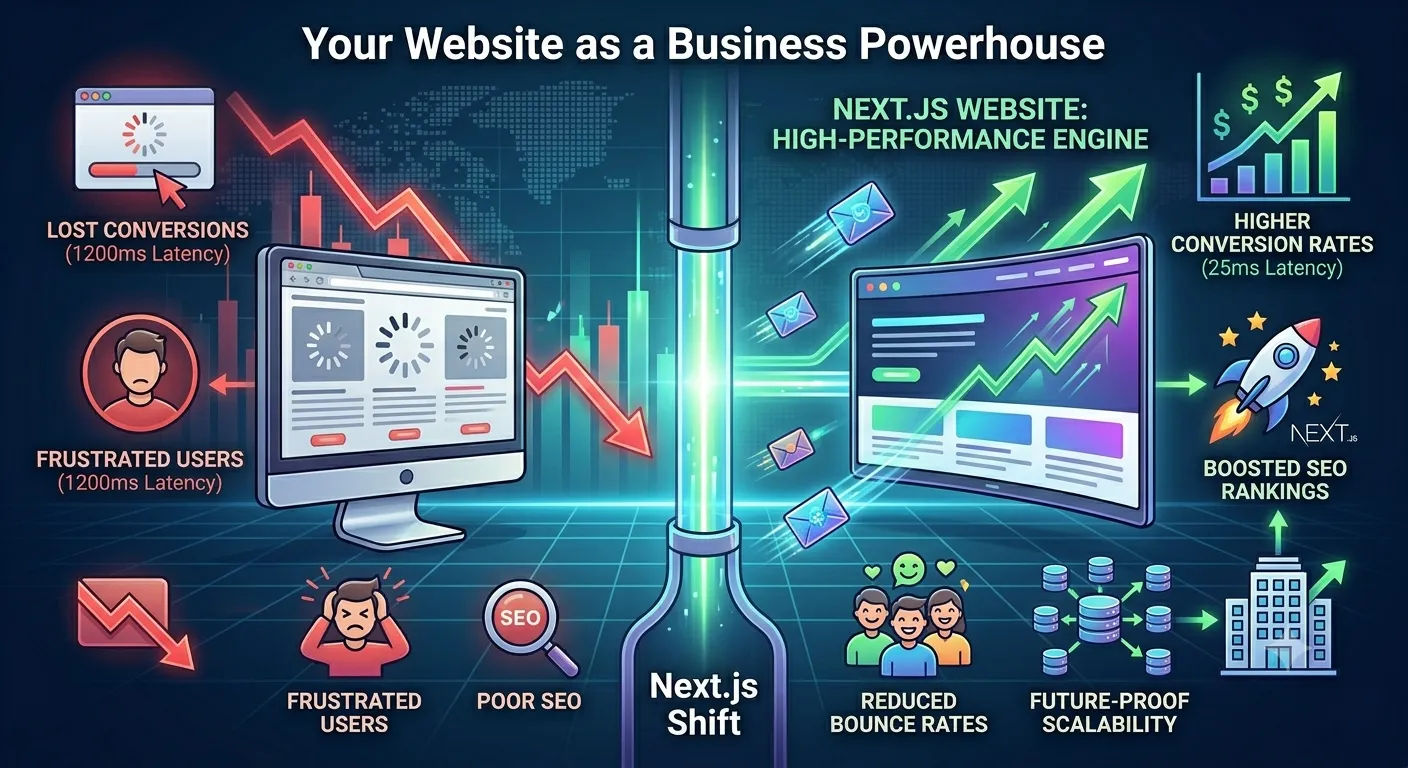
Why Your Business Needs a High-Performance Next.js Website: Beyond Just Code
Why Your Business Needs a High-Performance Next.js Website: Beyond Just Code
Introduction: Your Website as a Business Powerhouse
In today's digital-first economy, your business website is far more than just an online brochure. It's a critical sales tool, a customer service portal, a marketing engine, and often, the first impression a potential client has of your brand. But simply having a website isn't enough; its performance directly impacts your bottom line.
This is where modern frameworks like Next.js come into play, offering a significant competitive advantage that extends far beyond just elegant code.
The Performance Imperative: Speed Sells
Think about your own online habits. How long are you willing to wait for a page to load before hitting the back button? Studies consistently show that even a one-second delay in page load time can lead to a significant drop in conversions, page views, and customer satisfaction. For businesses, this translates directly to lost revenue. Next.js is built from the ground up for speed.
By leveraging Mastering Next.js Rendering techniques like SSR, SSG, and ISR, Next.js applications can deliver content to users incredibly fast. Server-Side Rendering (SSR) ensures that the initial page content is fully rendered on the server, while Static Site Generation (SSG) pre-renders pages at build time. Incremental Static Regeneration (ISR) provides the best of both worlds, allowing static pages to be updated in the background without a full redeploy. These capabilities dramatically reduce load times, improve core web vitals, and keep users engaged.
SEO Advantage: Be Seen, Be Found
What good is a fast website if no one can find it? Search Engine Optimization (SEO) is paramount for organic discovery, and Next.js is inherently SEO-friendly. Its server-side rendering ensures that search engine crawlers receive a fully formed HTML page, making it easier for them to index your content accurately.
Furthermore, Next.js makes it straightforward to implement robust SEO practices, including dynamic metadata management. With proper tools for Mastering Next.js Metadata for dynamic SEO titles, businesses can ensure that every page has optimized titles, descriptions, and Open Graph tags. A well-optimized Next.js site means higher rankings, more organic traffic, and ultimately, more leads and sales. To ensure search engines discover all these optimized paths automatically, it is essential to build an automatic SEO sitemap in Next.js 15 with Prisma.
Enhanced User Experience & Developer Efficiency
Beyond speed and SEO, Next.js contributes to a superior overall user experience. Its focus on performance means smoother interactions, faster navigations, and a more enjoyable journey for your visitors. This leads to lower bounce rates and higher engagement. To take user interface delivery even further, developers can utilize streaming architectures to prevent page blocking—learn more about this in our guide on Mastering Streaming and Suspense in Next.js.
From a development perspective, Next.js offers a fantastic environment with features like automatic code splitting, optimized image handling, and backend data capabilities. This efficiency means faster development cycles and the ability to seamlessly build an optimized hero image and featured posts section in Next.js with Prisma and Tailwind CSS, ensuring your site always looks and performs its best.
The Business Bottom Line
Investing in a Next.js website isn't just a technical decision; it's a strategic business move. It leads to:
Higher Conversion Rates: Faster sites mean happier users who are more likely to complete desired actions.
Improved SEO Rankings: Better visibility drives more organic traffic and potential customers.
Reduced Bounce Rates: Engaging, high-performance experiences keep users on your site longer.
Scalability & Future-Proofing: Built on React, Next.js offers a robust, scalable foundation for future corporate growth.
Cost Efficiency: While initial investment might be higher than a template, the long-term benefits in performance, SEO, and global deployment often lead to a greater ROI.
Conclusion: Stay Ahead with Next.js
In a fiercely competitive digital landscape, every advantage counts. A high-performance Next.js website isn't a luxury; it's a necessity for businesses aiming to thrive online. By prioritizing speed, SEO, and user experience, you're not just building a website – you're building a powerful engine for business growth. Embrace Next.js and give your business the digital foundation it deserves to stand out and succeed.
Latest from Wisemix Media

How to Build Agentic RAG Workflows with Next.js 15 & Prisma
Jun 18, 2026
Build a Scalable Micro-SaaS with Next.js 15 & WebGPU
Jun 18, 2026
The Shift to Vibe Coding: How to Architect Next.js 15 Apps When AI Writes 90% of Your Code
Jun 18, 2026
Is Anthropic Overhyped? The Honest Tech Stack Review of Claude Models and Pricing
Jun 17, 2026
Beyond Single Prompts: Architecting Multi-Agentic RAG Workflows with Next.js 15
Jun 17, 2026